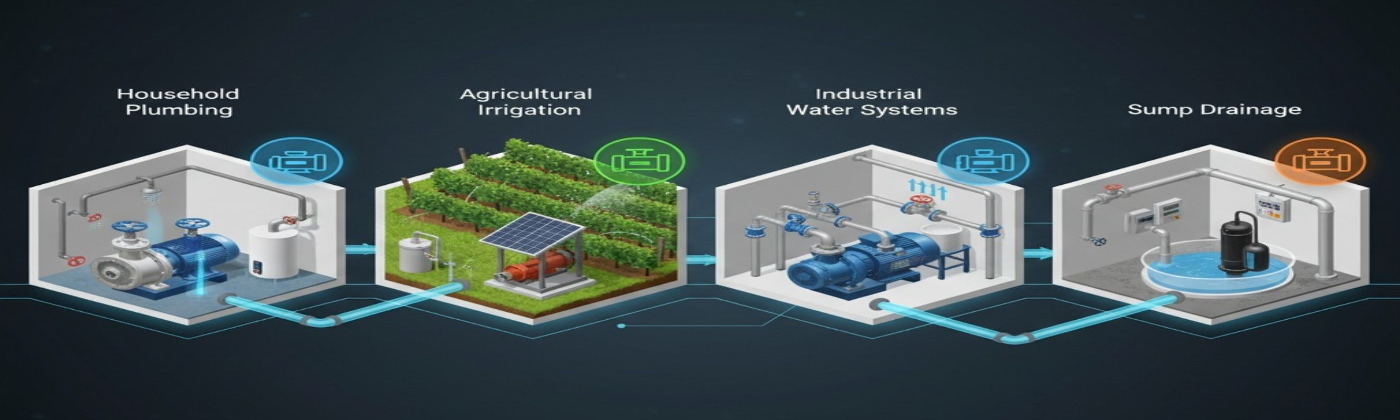
Water pumps are the unseen workhorses of our modern world. They silently power our daily lives, from delivering clean drinking water to our homes to irrigating vast agricultural fields. Imagine a life without them. It is a world without running tap water, functional sewage systems, or effective flood control. The reality is that over 80% of households use centrifugal pumps, highlighting their pervasive and critical role.
Choosing the correct pump for a specific task can feel overwhelming with so many options available. This definitive guide is your essential resource. It will help you navigate the complexity of pump types, understand their diverse applications, and identify the critical selection criteria. We will also cover essential maintenance tips to ensure optimal performance and longevity for your investment.
What You Will Discover in This Guide:
- What Are Water Pumps and How Do They Work?
- Detailed Types of Water Pumps and Their Specific Applications
- Common Uses and Applications of Water Pumps
- Answers to your most frequently asked questions.
Let us explore the fascinating world of water pumps together.
What Are Water Pumps and How Do They Work?
A water pump is a mechanical device that moves water from one point to another. It adds energy to the fluid, enabling it to overcome resistance caused by gravity, friction, and pressure differences. Pumps are crucial for countless applications, ensuring the efficient transfer of liquids wherever needed.
Key Components of a Water Pump
Despite their diverse designs, most water pumps share fundamental components that enable their operation. Understanding these parts helps in troubleshooting and maintenance.
- Motor: The motor provides the mechanical power to drive the pump. This can be electric, gasoline, diesel, or even solar powered. It converts electrical or fuel energy into rotational motion.
- Impeller/Rotor: This is the rotating component inside the pump that directly moves the water.
- In centrifugal pumps, the impeller has curved vanes that spin rapidly, imparting kinetic energy to the water.
- In positive displacement pumps, a rotor or other mechanism traps and displaces fluid.
- Casing/Volute: The casing is the stationary outer shell that encloses the impeller. In centrifugal pumps, the volute is a spiral-shaped channel within the casing. It collects the water discharged from the impeller and directs it towards the outlet. It also helps convert the water’s velocity into pressure.
- Seals (Mechanical, Gland Packing): Seals prevent water from leaking out of the pump where the rotating shaft passes through the stationary casing.
- Mechanical seals are precision-engineered components that offer a tight, leak-free barrier.
- Gland packing involves soft, braided material compressed around the shaft. It allows for a small, controlled leakage for lubrication.
- Inlet/Suction Port: This is where water enters the pump. It is designed to draw water efficiently from the source.
- Outlet/Discharge Port: This is where the pressurized water exits the pump to be delivered to its destination.
Broad Classifications: Dynamic (Kinetic) vs. Positive Displacement Pumps
All water pumps fall into one of two major categories. Each category operates on a distinct principle and suits different applications.
A. Dynamic (Kinetic) Pumps
Dynamic pumps are the most common type. They operate by continuously adding kinetic energy to the fluid as it moves through the pump.
- Working Principle: These pumps use a rotating impeller to accelerate the fluid. This converts rotational energy into kinetic energy (velocity). The pump casing then converts this high-velocity flow into pressure. They generate flow by creating a continuous, open path for the fluid.
- Key Characteristics:
- They provide a continuous flow of fluid.
- Pressure output can vary with changes in flow resistance.
- They are generally not self-priming, meaning the pump casing must be filled with water before starting to operate effectively.
- They are best suited for clean or low viscosity fluids.
- They are less effective with high-viscosity liquids or those containing large solids.
- Common Applications (General): These pumps are excellent for applications requiring high flow rates at lower to moderate pressures. Examples include general water transfer, irrigation, and industrial cooling.
B. Positive Displacement Pumps
Positive displacement pumps operate by trapping a fixed volume of fluid and then physically forcing that volume into the discharge pipe.
- Working Principle: These pumps use an expanding and contracting cavity to draw in and then expel fluid. They literally “displace” a set amount of fluid with each cycle of their mechanism. This can involve pistons, diaphragms, gears, or screws.
- Key Characteristics:
- They deliver a consistent flow rate, largely independent of discharge pressure.
- They are often self-priming, meaning they can draw air and evacuate it to create suction.
- They can handle viscous fluids and generate very high pressures.
- Flow can be pulsating depending on the mechanism.
- Common Applications (General): These pumps are ideal for applications requiring high pressure, precise dosing, or the handling of viscous fluids. Examples include chemical processing, hydraulic systems, and some types of agricultural spraying.
Comparison Table: Dynamic vs. Positive Displacement Pumps
| Feature | Dynamic (Centrifugal) Pumps | Positive Displacement Pumps |
| Mechanism | Impeller creates velocity, then pressure. | Traps and physically displaces a fixed volume. |
| Common Uses | General water transfer, irrigation, cooling, drainage. | High pressure, precise dosing, viscous fluid transfer. |
| Pros | Simple design, high flow rates, low initial cost. | Self-priming, consistent flow, high pressure, handles viscosity. |
| Cons | Not self-priming (usually), flow varies with pressure. | Pulsating flow, more complex, often higher maintenance. |
| Fluid Suitability | Clean, low viscosity fluids. | Viscous fluids, slurries, can handle solids (some types). |
Detailed Types of Water Pumps and Their Specific Applications
Now, let us explore the various types of water pumps within these two broad categories. We will examine how each works, its common uses, and its advantages and disadvantages.
A. Dynamic (Centrifugal) Pump Types: Versatility for Many Needs
Centrifugal pumps are the most widely used type. They offer a range of solutions for moving water and other fluids.
1. Standard Centrifugal Pumps
These are the most basic and common form of dynamic pump.
- How They Work: An electric motor spins an impeller at high speed inside a casing. Water enters the impeller at its center (the “eye”). The impeller’s rotation throws the water outwards due to centrifugal force, increasing its velocity. The volute casing then slows down this high-velocity water, converting its kinetic energy into pressure. This pressurized water then exits the pump through the discharge port.
- Uses: These pumps are workhorses for general water transfer tasks. They are commonly found in irrigation systems, industrial cooling towers, domestic water supply from tanks, and commercial HVAC systems. You see them moving water from one point to another in factories or within building water systems.
- Pros & Cons:
- Pros: They are known for their simplicity in design, high flow rates, and cost effectiveness. They are easy to maintain and widely available.
- Cons: They are generally not self-priming, requiring manual filling of the casing and suction line before operation. They are also less efficient with highly viscous liquids.
2. Submersible Pumps
Submersible pumps are unique because they operate completely underwater.
- How They Work: The pump and its motor are sealed together in a watertight casing, designed to be fully submerged in the fluid. Water enters the pump through a screen, passes through the impeller, and is then pushed upwards through the discharge pipe. Because the motor is submerged, the water helps to cool it, preventing overheating. The weight of the water above also helps to push water into the pump.
- Uses: These pumps are invaluable for accessing water from deep sources. They are extensively used in well water systems for homes and farms, boreholes, and sump pits to prevent basement flooding. You also find them in sewage and wastewater applications, dewatering construction sites, and creating beautiful fountains or water features.
- Pros & Cons:
- Pros: They are remarkably quiet because they operate underwater. They are highly efficient as they do not need to “lift” water through suction, only push it. Priming issues are virtually eliminated.
- Cons: Accessing them for maintenance or repair can be difficult and costly. The sealed motor requires specialized repair.
- Installation Tips: Ensure the pump is suspended correctly in the well or sump, never resting on the bottom. Use a safety rope and proper electrical connections that are watertight. Always follow the manufacturer’s depth and cable length recommendations.
2. Jet Pumps
Jet pumps use a clever principle to create suction, often for shallow or deep wells.
- How They Work: A jet pump is a surface-mounted pump that uses an additional component called an ejector or jet assembly. A portion of the pump’s discharge water is diverted back to the ejector, which is located either directly on the pump (for shallow wells) or down in the well itself (for deep wells). This diverted water creates a high-velocity jet. This jet creates a low-pressure zone, known as the venturi effect, which pulls more water from the well into the suction line.
- Uses: They are very common for shallow wells (up to 25 feet) in residential settings. With a deep well ejector assembly, they can also serve deep wells (up to 90 feet). They are also used for pressure boosting applications where a consistent water supply needs a pressure increase.
- Pros & Cons:
- Pros: They are versatile for both shallow and deep well applications. They are relatively easy to install and maintain because they are surface-mounted.
- Cons: They can be noisy during operation. They are generally less efficient than submersible pumps for deep well applications.
4. Pumps
Sump pumps are a critical defense against basement flooding.
- How They Work: A sump pump is typically installed in a sump pit, which is a hole dug in the lowest part of a basement or crawl space. As water collects in the pit, a float switch rises. When the water level reaches a preset point, the float switch activates the pump. The pump then quickly discharges the water away from the foundation, often into a storm drain or designated discharge area.
- Uses: Their primary use is basement flood prevention and crawl space drainage. They protect homes from water damage caused by heavy rains or plumbing leaks.
- Pros & Cons:
- Pros: They are absolutely essential for flood protection in areas prone to water accumulation. Many models offer reliable, automatic operation.
- Cons: They require a power source and can fail during power outages unless connected to a battery backup system. They also need periodic cleaning to prevent clogs.
5. Booster Pumps
Booster pumps are designed to increase water pressure in an existing system.
- How They Work: These pumps are installed inline with a water supply system that has insufficient pressure. They contain an impeller that spins rapidly, drawing in water at a lower pressure and discharging it at a higher pressure. Many modern booster pumps incorporate variable speed drives to maintain a constant pressure regardless of demand, saving energy.
- Uses: They solve the frustrating problem of low domestic water pressure in homes, especially in high-rise buildings or rural areas. They are also used to enhance pressure in irrigation systems and in various industrial processes where a consistent, higher pressure is required.
- Pros & Cons:
- Pros: They effectively solve low-pressure problems, improving shower performance and appliance efficiency. Variable speed models are energy-efficient.
- Cons: They can be noisy if not properly installed or if undersized. They consume electricity, adding to utility costs
6. Circulating Pumps (Circulators)
Circulating pumps are designed for moving fluids within closed-loop systems.
- How They Work: These pumps have a compact design and typically feature a small impeller that continuously moves water or other heat transfer fluids within a closed system. They are not designed to create high pressure, but rather to maintain a steady flow. The motor is often “wet rotor” design, meaning it operates within the pumped fluid, making it very quiet and maintenance-free.
- Uses: They are fundamental to HVAC heating and cooling systems, ensuring even heat distribution or efficient cooling. They are also widely used for hot water recirculation in homes, providing instant hot water at faucets. You also find them in pool filtration systems to keep water clean.
- Pros & Cons:
- Pros: They provide continuous, low-energy flow. They are typically very quiet and often require little to no maintenance.
- Cons: They are not suitable for high-pressure or high-lift applications.
7. Trash Pumps
Trash pumps are built to handle the toughest dewatering jobs.
- How They Work: Unlike standard centrifugal pumps, trash pumps feature large impellers and robust casings. Their design allows them to pass solids, debris, and sludge without clogging. They often have a removable front cover for easy access to the impeller and volute for cleaning. Many are engine-driven for portability.
- Uses: These heavy-duty pumps are essential for construction site dewatering, rapidly removing water from trenches and excavations. They are critical for flood cleanup after natural disasters and for handling sewage, sludge, and other liquids containing large solids and debris.
- Pros & Cons:
- Pros: They can handle extremely tough conditions and pass significant amounts of solids. They offer high volume pumping for rapid dewatering.
- Cons: They are generally larger, heavier, and more expensive than standard water pumps. They are also often noisier, especially engine-driven models.
8. Axial Flow & Mixed Flow Pumps
These pumps specialize in moving very large volumes of water at lower heads.
- How They Work:
- Axial Flow Pumps: These are like propellers in a pipe. Water flows axially (straight) through the impeller, which pushes it forward. They generate flow primarily by the lifting action of the propeller blades.
- Mixed Flow Pumps: These combine aspects of both centrifugal and axial flow. Water moves both radially (outwards) and axially through the impeller, creating a blend of pressure and flow.
- Uses: They are vital for very high volume irrigation in large agricultural settings, drainage projects, and flood control systems where vast amounts of water need to be moved over short distances.
- Pros & Cons:
- Pros: They deliver very high flow rates. They are efficient for low-head, high-volume applications.
- Cons: They generate lower head (pressure) compared to centrifugal pumps. They are highly specialized and not suitable for high-pressure needs.
9. Garden Pumps: Typically portable, surface-mounted centrifugal pumps used for watering gardens from rain barrels or shallow sources.
10. Pipeline Pumps: Large, high-capacity pumps used in municipal water distribution networks to push water over long distances.
11. Multistage Pumps: Contain multiple impellers arranged in series to generate significantly higher pressures than single-stage pumps. They are used for high-rise building water supply and boiler feed.
B. Positive Displacement Pump Types: Precision and Power
Positive displacement pumps offer different strengths, particularly for high-pressure or viscous fluid handling.
1. Piston Pumps
Piston pumps use a reciprocating motion to displace fluid.
- How They Work: These pumps contain one or more pistons that move back and forth (reciprocate) within a cylinder. As a piston retracts, it creates a vacuum, drawing fluid into the cylinder through an inlet valve. As the piston moves forward, it pushes the trapped fluid out through a discharge valve. The valves open and close in synchronization with the piston’s movement.
- Uses: Piston pumps are known for generating very high pressures. They are used in high-pressure washing equipment, agricultural spraying (e.g., pesticides, herbicides), and for transferring oils and other viscous fluids in industrial settings.
- Pros & Cons:
- Pros: They can generate very high pressures and handle viscous fluids effectively. They offer precise, controllable flow rates.
- Cons: The flow can be pulsating due to the reciprocating action. They are typically more complex with more moving parts, potentially leading to higher maintenance.
2. Diaphragm Pumps
Diaphragm pumps use a flexible membrane to move fluid.
- How They Work: A flexible diaphragm, usually made of rubber or Teflon, moves back and forth within a pump chamber. When the diaphragm moves away from the chamber, it creates a vacuum, drawing fluid in. When it moves towards the chamber, it expels the fluid. Check valves ensure one-way flow. The diaphragm can be actuated mechanically, hydraulically, or by compressed air.
- Uses: These pumps are excellent for handling a wide range of fluids, including corrosive and abrasive ones. They are common in chemical transfer, precise dosing applications, food processing where gentle handling is needed, and for wastewater treatment to move slurries.
- Pros & Cons:
- Pros: They have no seals that come into contact with the fluid, making them ideal for corrosive or sensitive liquids. They are self-priming and can handle abrasive particles without damage.
- Cons: They generally produce less flow than centrifugal pumps. The diaphragm can wear out over time, requiring replacement.
3. Gear Pumps
Gear pumps use meshing gears to trap and transfer fluid.
- How They Work: Two meshing gears (external or internal) rotate within a tightly fitted casing. As the gears rotate, fluid is trapped in the spaces between the gear teeth and the casing. This fluid is then carried around the periphery of the casing and forced out through the discharge port as the teeth re-mesh.
- Uses: Gear pumps are widely used for transferring oils, fuels, and other viscous fluids. They are found in fuel injection systems, lubrication systems, and various viscous fluid processing applications in industrial settings.
- Pros & Cons:
- Pros: They provide a consistent, pulsation-free flow. They are highly effective for high viscosity fluids and can generate high pressures.
- Cons: They are limited in handling solids as these can damage the gears. Wear on the gears can reduce efficiency over time.
4. Screw Pumps
Screw pumps use one or more rotating screws to move fluid.
- How They Work: These pumps feature one or more intermeshing screws that rotate within a close-fitting casing. As the screws turn, they create sealed cavities that trap fluid. The rotation then moves these cavities axially along the length of the screws, effectively pushing the fluid from the suction end to the discharge end.
- Uses: Screw pumps excel at handling wastewater treatment (especially activated sludge), oil and gas transfer, and very highly viscous fluids such as crude oil, bitumen, or food pastes. They are also used for pumping fluids containing solids.
- Pros & Cons:
- Pros: They can achieve high pressures and handle very viscous fluids and solids with ease. They typically operate quietly and provide a smooth, pulsation-free flow.
- Cons: They can be more expensive than other pump types. The design can be complex.
5. Lobe Pumps
Lobe pumps are similar to gear pumps but use non-contacting lobes.
- How They Work: Instead of gears, lobe pumps use two or more rotating lobes that mesh without making contact. As the lobes rotate, they create expanding and contracting cavities, trapping fluid and carrying it from the inlet to the outlet. The non-contacting design means they are gentle on the fluid.
- Uses: They are favored in the food and beverage industry for transferring products like sauces, creams, and purees, as well as in pharmaceuticals due to their hygienic design. They are also good for gentle handling of solids in suspension.
- Pros & Cons:
- Pros: They are highly hygienic and easy to clean (CIP/SIP capable). They are excellent for handling solids in suspension without damaging them. They provide a gentle pumping action.
- Cons: They generate less pressure than gear pumps. They can be more expensive.
6. Peristaltic Pumps (Hose Pumps)
Peristaltic pumps use rollers to squeeze a flexible tube.
- How They Work: A flexible tube is housed within a circular casing. Rollers or shoes attached to a rotor compress the tube against the casing wall. As the rotor turns, the compression point moves along the tube, creating a vacuum behind it that draws fluid in. The fluid ahead of the compression point is pushed out. The fluid only contacts the inside of the tube.
- Uses: These pumps are excellent for medical equipment (e.g., IV drips), chemical dosing (acids, alkalis), and laboratory applications where precise, contamination-free fluid transfer is crucial. They are also used for slurries and viscous liquids.
- Pros & Cons:
- Pros: They offer complete sterility and contamination-free pumping because the fluid never touches any pump components other than the tube. They provide precise dosing and are self-priming.
- Cons: They are limited in the pressure they can generate. The flexible tube needs periodic replacement, especially with aggressive fluids.
7. Rotary Vane Pumps: Use vanes that slide in and out of slots in a rotor to trap and move fluid. They are common for vacuum applications and fuel transfer.
8 Regenerative Pumps: Also known as peripheral pumps, they use an impeller with many small vanes to impart energy to the fluid repeatedly, generating high head at low flow rates.
9. Macerator Pumps: Often combined with sewage pumps, they include a cutting mechanism to break down solids before pumping, preventing clogs.
Common Uses and Applications of Water Pumps
Water pumps are fundamental to almost every aspect of our lives, ensuring efficient fluid management across diverse sectors.
1. Residential Uses
At home, pumps work tirelessly behind the scenes to enhance comfort and safety.
- Plumbing Systems (Pressure Boosting): Many homes, particularly older ones or those in high areas, suffer from low water pressure. Booster pumps solve this, ensuring strong showers and efficient appliance operation.
- Swimming Pools & Hot Tubs (Circulation, Filtration): Circulating pumps continuously move water through filters, heaters, and sanitizers, keeping the water clean, clear, and at the right temperature.
- Sump/Sewage (Basement Dewatering, Septic Systems): Sump pumps prevent basement flooding by removing excess water. Sewage pumps, often with macerators, handle wastewater from bathrooms below sewer lines or in septic systems.
- Garden & Lawn Irrigation: Garden pumps draw water from rain barrels, ponds, or shallow wells to water lawns and gardens, offering an eco-friendly and cost-effective solution.
2. Agricultural and Irrigation Systems
Agriculture relies heavily on pumps for productivity and resource management.
- Field Irrigation (Sprinklers, Drip Systems): High-volume centrifugal pumps, axial flow, and mixed flow pumps deliver water from rivers, lakes, or wells to vast fields through sprinkler or drip irrigation systems.
- Livestock Watering: Pumps ensure a consistent supply of fresh water for animals on farms and ranches.
- Drainage: Pumps are crucial for draining excess water from fields after heavy rainfall, preventing crop damage and waterlogging.
- Crop Spraying: Piston or diaphragm pumps deliver precise amounts of fertilizers, pesticides, and herbicides at high pressure for effective crop treatment.
3. Industrial and Commercial
Industries depend on pumps for critical processes and infrastructure.
- HVAC (Heating/Cooling): Circulating pumps move chilled or heated water through commercial and industrial HVAC systems, maintaining climate control within buildings.
- Chemical Processing: Diaphragm and peristaltic pumps handle corrosive, abrasive, or sensitive chemicals with precision and safety.
- Manufacturing: Pumps transfer fluids for cooling, lubrication, and product conveyance in countless manufacturing processes.
- Boiler Feed: Multistage pumps deliver high-pressure water to boilers in power plants and industrial facilities.
- Wastewater Treatment: Various pump types, including screw, submersible, and trash pumps, move raw sewage, sludge, and treated water through different stages of a treatment plant.
- Mining: Heavy-duty trash pumps and slurry pumps dewater mines and transport abrasive slurries.
4. Municipal Applications
Pumps are at the heart of public services, ensuring healthy and safe communities.
- Water Supply (from wells/reservoirs): Large centrifugal or deep well submersible pumps draw raw water from sources and deliver it to treatment plants and distribution networks.
- Wastewater Treatment Plants: Pumps are integral to every stage, moving sewage from collection points to treatment and then discharging treated effluent.
- Flood Control (Stormwater): Massive axial flow or mixed flow pumps are deployed in urban areas to quickly move large volumes of stormwater, preventing widespread flooding.
- Firefighting: High-pressure fire pumps are critical components of fire suppression systems in buildings and on fire trucks.
5. Emergency & Specialized
Some applications require specific pump capabilities for unique or critical situations.
- Construction Dewatering: Trash pumps are essential for removing water from construction sites, allowing work to proceed safely and efficiently.
- Marine Applications (Bilge Pumps): Submersible bilge pumps remove water that accumulates in the hull of boats and ships, preventing sinking.
- Oil & Gas Transfer: Screw and gear pumps are used to transfer crude oil, refined fuels, and other viscous hydrocarbons in pipelines, refineries, and storage facilities.
6. Location-Specific Considerations
The environment often dictates the ideal pump type.
- Rural Areas (Well Pumps): Deep well submersible pumps or jet pumps are common to draw water from underground aquifers for domestic and agricultural use.
- High-Rise Buildings (Pressure Boosting Systems): Multistage booster pumps are necessary to maintain adequate water pressure on upper floors against gravity.
Frequently Asked Questions (FAQ) about Water Pumps
Here are direct, concise answers to some of the most common questions about water pumps.
What is the difference between centrifugal and positive displacement pumps?
Centrifugal pumps use a spinning impeller to create velocity, converting it into pressure for continuous flow. Positive displacement pumps trap a fixed volume of fluid and physically push it forward with each cycle. Centrifugal pumps are for high flow, lower pressure, while positive displacement pumps excel at high pressure and viscous fluids.
Which pump is best for well water?
For deep wells, a submersible pump is usually best. It is highly efficient, quiet, and pushes water from within the well. For shallow wells (up to 25 feet), a jet pump is a common and effective surface-mounted option, using an ejector to create suction.
Can I use a sump pump for sewage?
No, generally you cannot use a standard sump pump for sewage. Sump pumps are designed for clear or grey water with minimal solids. Sewage contains large solids and fibrous materials that would quickly clog and damage a standard sump pump’s impeller. You need a specialized sewage ejector pump or a trash pump designed to handle solids.
How often should I maintain my water pump?
Maintenance frequency depends on pump type, usage, and fluid quality. For residential pumps, annual inspection and cleaning of screens are often sufficient. Industrial or heavy-use pumps, or those handling dirty water, may require monthly or quarterly checks. Always follow the manufacturer’s specific guidelines for your model.
What causes a water pump to lose prime?
A water pump loses prime when air enters the suction line or the pump casing. Common causes include air leaks in the suction piping, a low water level in the source, a faulty check valve, a broken foot valve, or simply not having enough water in the pump casing before starting (for non-self-priming pumps).
How can I make my water pump more energy-efficient?
To make your pump more energy-efficient, choose the correctly sized pump for your needs, use a variable speed drive (VSD) to match demand, ensure clean intake screens and impellers, minimize pipe bends and reduce pipe length to lower friction loss, and perform regular maintenance.
Why is my water pump making a humming noise but not pumping water?
This usually indicates that the pump motor is receiving power but the impeller is seized or blocked. It could be due to debris clogging the impeller, worn bearings, or an electrical issue preventing the motor from turning properly. Always disconnect power before inspecting.
Can low voltage damage a water pump?
Yes, operating a pump with consistently low voltage can cause the motor to draw excessive current, leading to overheating, insulation breakdown, and premature motor failure. Always ensure your pump receives the correct voltage specified by the manufacturer.
What is the typical lifespan of a residential water pump?
The typical lifespan of a residential water pump varies widely depending on type, quality, usage, and maintenance. A well-maintained quality pump can last 10 to 15 years, while a sump pump might last 7 to 10 years. Poor maintenance or continuous heavy use can significantly shorten this.
How do I size a pump for irrigation?
Sizing an irrigation pump involves calculating the total water flow required by all sprinklers or drip emitters operating simultaneously (GPM) and the total dynamic head. This head includes the vertical lift from the water source, the pressure needed at the furthest sprinkler, and friction losses in the irrigation piping.
Can I run my well pump on a generator?
Yes, you can run a well pump on a generator, but you must ensure the generator has sufficient wattage to handle the pump’s starting and running power requirements. Well pumps often have high starting (surge) wattage, so a generator with ample capacity is necessary.
Empowering Your Water Management Decisions
Water pumps are truly the unsung heroes of our infrastructure, powering everything from a refreshing shower to massive agricultural endeavors. This guide has taken you through the intricate world of pump types, their specific applications, and the vital factors that govern their selection and care. You now understand the fundamental differences between dynamic and positive displacement pumps, how each type operates, and where it excels. We have explored the critical aspects of calculating flow and head, choosing the right power source, and considering material durability.
Armed with this comprehensive knowledge, you are ready to make smart choices for your water management needs. If you are still unsure, do not hesitate to seek professional advice. Contact a certified pump specialist for personalized guidance or explore our resources further.
Explore additional plumbing resources and home care tips on our Blog.